

Introduction to the Unemployment Challenge
In my previous article, I unpacked the demographics behind South Africa’s unemployment crisis. Rather than focusing only on the headline figure of more than 32% unemployment, I explored who is most likely to be unemployed. The evidence showed that unemployment disproportionately affects young people, women, Black South Africans, people without tertiary education, rural communities, and first-time job seekers. These patterns reflect the country’s history, geography, education system and labour market, all of which continue to shape who has access to economic opportunities and who is left behind.
Understanding who is unemployed, however, only answers part of the question. An equally important question is why South Africa continues to experience unemployment on a scale that is almost unmatched anywhere else in the world. More than thirty years after democracy, successive governments have recognised unemployment as one of the country’s greatest challenges. Numerous policies have been introduced, strategies have been rewritten, commissions have been established and billions of rands have been spent on programmes intended to stimulate growth and employment. Yet unemployment has remained persistently high, even during periods of relatively strong economic growth.
Among upper-middle-income countries, South Africa records the highest unemployment rate by a considerable margin (see Figure 1). While unemployment in comparable economies generally ranges between five and ten percent, South Africa’s official unemployment rate remains above thirty percent.
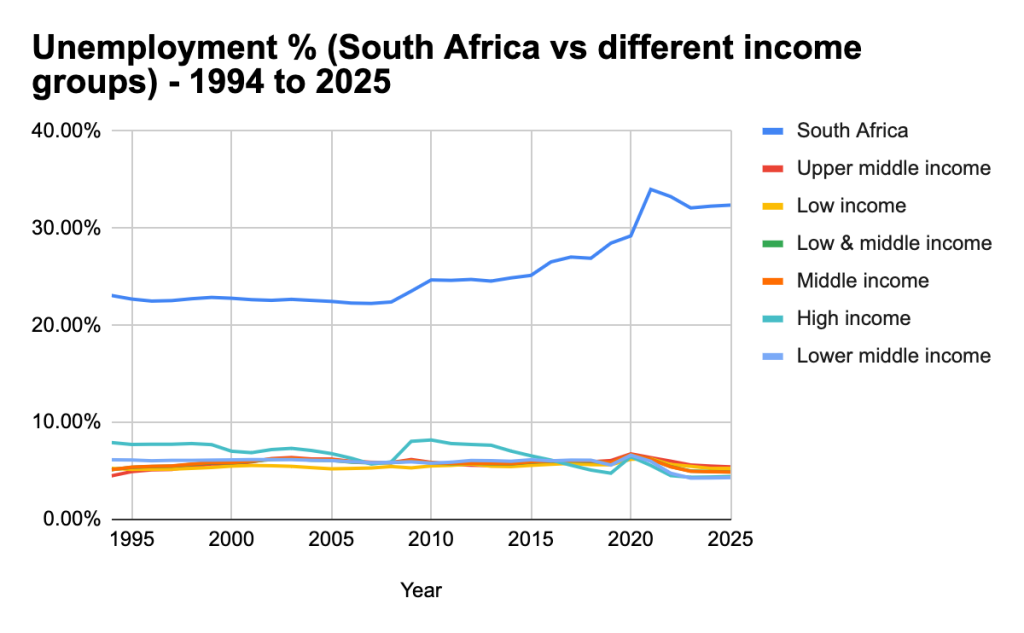
Figure 1: South Africa unemployment % vs averages of different income countries. Data source: World Bank open data accessed on 1 July 2026, chart developed by author
Within the BRICS geopolitical bloc, South Africa’s average unemployment rate (25.42%) is approximately two to six times higher than those of Russia, India, China, and Brazil (see Figure 2) While Brazil and Russia have grappled with macroeconomic shocks, their labor markets have exhibited cyclical elasticity, with unemployment rates reverting to single digits during periods of stabilisation. Conversely, South Africa’s unemployment has behaved as a structural floor, failing to dip below even during the commodity-driven domestic expansion of the mid-2000s.
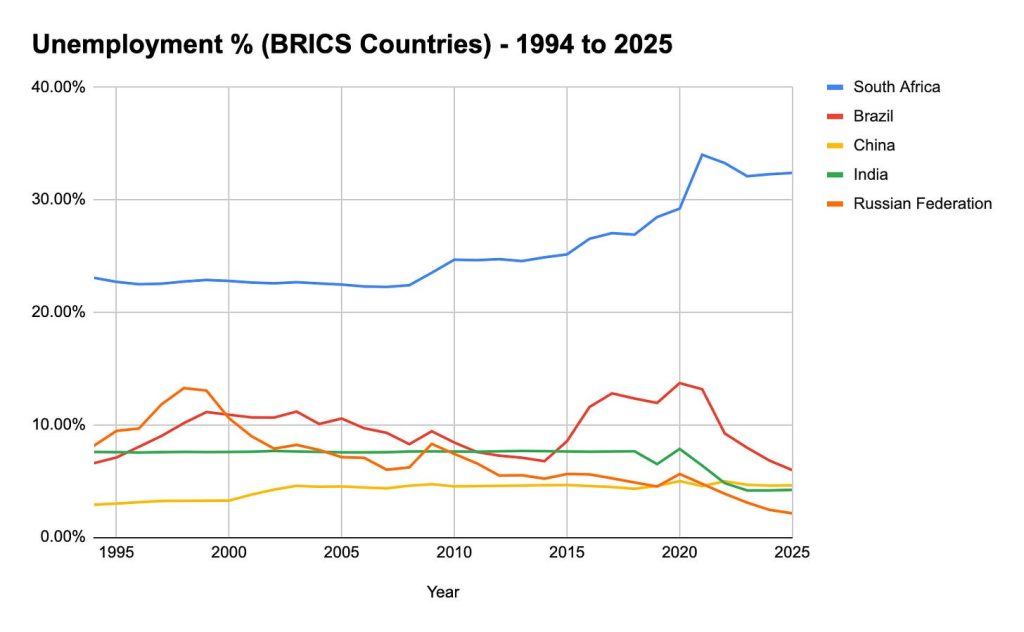
Figure 2: South Africa’s unemployment rate (%) vs BRICS countries. Data source: World Bank open data accessed on 1 July 2026, chart developed by author
Thanks for reading Built for People (Or Not)! Subscribe for free to receive new posts and support my work.
High unemployment affects household incomes, food security, public finances, crime, mental health, social cohesion and confidence in democratic institutions. It also represents a tremendous waste of human potential. Every unemployed graduate unable to find work, every young person who leaves school without prospects, and every experienced worker who becomes discouraged from seeking employment represents skills and productivity that the economy is failing to utilise. Economists have long argued that unemployment carries costs well beyond lost wages. It slows economic growth itself because fewer people are producing goods and services, fewer households are spending money, and government collects less revenue to reinvest in public services.
The scale of South Africa’s unemployment crisis has also led to increasingly polarised debates about what should be done. Some argue that government intervention has gone too far and that reducing regulation, privatising state assets and allowing markets greater freedom would encourage businesses to invest and employ more people. Others argue that the state has not intervened effectively enough, pointing to countries that successfully used industrial policy, strategic investment and active government coordination to build globally competitive industries and create millions of jobs. These competing schools of thought have shaped South Africa’s economic policy since the advent of democracy, often resulting in policy shifts as governments sought new approaches to stimulate growth and employment.
This article does not seek to revisit every ideological debate surrounding economic policy. Instead, it asks a simpler question: what does the evidence tell us? More specifically, why have successive policy interventions struggled to reduce unemployment, and what lessons can South Africa draw from both its own experience and that of other countries? My thinking is strongly influenced by economists such as Duma Gqubule, Ha-Joon Chang and Mariana Mazzucato, all of whom argue that economic development requires capable institutions and an active state that works alongside markets rather than leaving development entirely to market forces. Whether one agrees with every aspect of their work is less important than recognising that the international evidence increasingly suggests that successful economies rarely emerged through markets alone.
Thirty years of trying to solve unemployment
One misconception often repeated in public discourse is that South Africa has lacked policies to address unemployment. In reality, the country has produced no shortage of economic strategies since 1994. The challenge has not been the absence of policy, but rather the difficulty of translating policy ambitions into sustained employment growth. Gqubule unpacks the different policies since 19941 and I have tried summarising this below.
The first democratic government inherited an economy deeply shaped by apartheid. Decades of racial exclusion had left millions of South Africans without adequate education, skills, infrastructure and access to productive economic opportunities. The Reconstruction and Development Programme (RDP), introduced in 1994, sought to address these inequalities by expanding housing, basic services, healthcare and education while simultaneously stimulating economic development. The programme recognised that social development and economic growth were closely linked. Communities without electricity, roads, schools or healthcare facilities were unlikely to participate fully in the economy.
Only two years later, government adopted the Growth, Employment and Redistribution (GEAR) strategy. Whereas the RDP had emphasised redistribution and reconstruction, GEAR placed greater emphasis on fiscal discipline, macroeconomic stability, reducing budget deficits, attracting investment and integrating South Africa into the global economy. Policymakers believed that a stable macroeconomic environment would encourage private investment, which in turn would generate economic growth and employment. Although inflation declined and public finances improved during this period, employment growth fell well short of expectations. Economic growth occurred, but much of it proved insufficiently labour-intensive to absorb the rapidly growing labour force.
Recognising these shortcomings, subsequent administrations introduced additional strategies aimed at accelerating employment creation. The Accelerated and Shared Growth Initiative for South Africa (ASGISA) sought to remove key constraints to economic growth through infrastructure investment and improved public sector coordination. This was followed by the New Growth Path, which placed greater emphasis on industrial development, manufacturing, localisation and employment-intensive sectors. The National Development Plan later attempted to provide a longer-term vision for inclusive growth by combining improvements in education, infrastructure, governance and economic competitiveness. Following the COVID-19 pandemic, the Economic Reconstruction and Recovery Plan once again prioritised infrastructure, industrialisation and employment as central pillars of economic recovery.
Each of these strategies reflected different assumptions about how jobs would be created. Some emphasised fiscal stability and private investment, while others focused on industrial policy, infrastructure or state-led development. Yet despite these changing priorities, unemployment remained stubbornly high throughout much of the democratic period. South Africa experienced periods of respectable economic growth during the early 2000s, but even then employment creation failed to keep pace with the growth of the labour force. Following the global financial crisis in 2008, economic growth slowed considerably, making the challenge even more difficult.
This history offers an important lesson. South Africa’s unemployment crisis cannot be attributed to a single administration, a single president or a single policy framework. Nor can it be solved by replacing one strategy with another while leaving the country’s underlying structural constraints unchanged. The persistence of unemployment across multiple governments suggests that the problem is deeper than political cycles. It reflects longstanding weaknesses in education, infrastructure, industrial capacity, spatial inequality, institutional capability and labour absorption that cannot be addressed through isolated interventions.
Understanding the scale of the challenge
Perhaps the greatest misunderstanding about unemployment in South Africa concerns its sheer scale. Public debate often celebrates announcements that tens of thousands of jobs have been created or expresses disappointment when employment declines over a particular quarter. While these numbers matter, they often obscure the magnitude of the challenge facing the country.
Every year, thousands of young South Africans complete school, graduate from universities and technical colleges, or otherwise enter the labour market looking for work. At the same time, population growth, migration and changing labour force participation mean that the economy must continuously generate new employment opportunities simply to prevent unemployment from rising further. Solving unemployment is therefore not only about finding jobs for those who are currently unemployed; it is also about ensuring that future labour market entrants are successfully absorbed into productive employment.
Economists Duma Gqubule and Neil Coleman2 have argued that many discussions about economic growth underestimate this reality. Even under highly optimistic assumptions, sustained economic growth of around 6 percent per year until 2035 would still leave South Africa with an unemployment rate exceeding twenty-six percent. In other words, growth alone, even at levels significantly higher than the country has achieved in recent years, would not be sufficient to eliminate mass unemployment.
South Africa currently has more than twelve million unemployed people using the expanded definition of unemployment. Over the coming decade, millions more young people will enter the labour market as they complete their education or begin seeking work for the first time. Taken together, the country would need to create close to twenty million jobs over the next ten years merely to approach something resembling full employment. That equates to approximately two million jobs every year, far beyond anything the economy has previously achieved.
These figures demonstrate why unemployment cannot be solved through short-term employment programmes or isolated policy interventions alone. The scale of the challenge requires an economy capable of sustained, employment-intensive growth over many years. It also requires recognising that job creation is not the responsibility of government alone. Businesses, educational institutions, organised labour, financial institutions and civil society all play critical roles in shaping whether economic growth ultimately translates into employment opportunities. Understanding how these actors interact, and what policies enable them to create jobs at scale, is therefore essential if South Africa is to move beyond managing unemployment towards genuinely reducing it.
What kind of economy creates jobs?
Understanding who is unemployed is only one part of South Africa’s unemployment crisis. An equally important question is why these same demographic patterns continue to appear more than thirty years after democracy. Why are Black South Africans still considerably more likely to be unemployed than white South Africans? Why are young people struggling to enter the labour market? Why do workers without tertiary education continue to experience disproportionately high levels of unemployment? Answering these questions requires looking beyond today’s labour market and understanding the economy that democracy inherited in 1994.
Apartheid was an economic system deliberately designed to allocate opportunity according to race. Black South Africans were systematically denied quality education, excluded from skilled occupations through job reservation, prevented from owning land across most of the country, and confined to townships and homelands located far from centres of economic activity. Infrastructure investment, industrial development and financial services overwhelmingly favoured white communities, while millions of Black South Africans were expected to supply cheap labour to mines, farms and factories without sharing in the wealth those industries created. By the time democracy arrived, South Africa had inherited one of the most unequal economies in the world, characterised not only by unequal incomes but also by unequal access to assets, education, transport, finance and economic opportunity.
While political democracy arrived in 1994, economic transformation is a far longer process from South Africa’s experience. Successive democratic governments have attempted to address these inherited inequalities through different policy approaches. The Reconstruction and Development Programme (RDP) focused on expanding housing, healthcare, education and basic services. The Growth, Employment and Redistribution (GEAR) strategy shifted towards fiscal discipline and attracting private investment. Later strategies such as ASGISA, the New Growth Path, the National Development Plan and the Economic Reconstruction and Recovery Plan all introduced new priorities, ranging from infrastructure investment to industrial development and localisation.
Each of these strategies reflected different ideas about how employment would be created. Some placed greater faith in market-led growth, while others argued for a stronger developmental role for the state. Yet despite these shifts, unemployment remained persistently high. This does not necessarily mean that every policy failed. Millions of houses were built, access to electricity and clean water expanded dramatically, and macroeconomic stability improved during parts of the democratic period. Rather, it suggests that the scale of South Africa’s structural unemployment is deeper than any single policy framework has been able to address.
One reason is that South Africa’s economy has itself changed considerably over the past few decades. Historically, sectors such as mining, agriculture and manufacturing employed large numbers of workers, including people with relatively limited formal education. Although these sectors were often characterised by exploitative labour practices under apartheid, they nevertheless provided employment to millions of South Africans. Over time, however, technological change, global competition, mechanisation and declining industrial competitiveness have reduced the number of workers these sectors require. Manufacturing’s contribution to employment has steadily declined, while finance, professional services and technology have become increasingly important contributors to economic output.
Many of the sectors experiencing the strongest growth today require higher levels of education, specialised skills and previous work experience. At the same time, the sectors that historically absorbed large numbers of semi-skilled and lower-skilled workers employ far fewer people than they once did. This helps explain many of the demographic patterns discussed in the previous article. Young people entering the labour market without experience, workers without tertiary education and communities that were historically excluded from quality education now face an economy that increasingly rewards skills they were never given the opportunity to acquire. The labour market has therefore become more competitive at precisely the moment when many South Africans remain disadvantaged by inequalities created decades earlier.
These structural realities mean that we cannot simply focus on increasing economic growth and hope that jobs follow automatically. Growth certainly matters, but the composition of that growth matters equally. An economy driven primarily by highly skilled services will not absorb unemployment in the same way as one that also expands manufacturing, construction, logistics, agriculture and other labour-intensive industries. The question is therefore not only how fast South Africa grows, but what kind of economy it chooses to grow.
Economists such as Ha-Joon Chang, Mariana Mazzucato and Duma Gqubule argue that governments have an important role in shaping markets rather than merely correcting their failures after they occur. Looking at countries such as Japan, South Korea, Taiwan, Singapore and, more recently, China, they observe that successful industrialisation rarely occurred through market forces alone. Governments invested heavily in infrastructure, supported strategic industries, coordinated long-term investment, developed technical skills, financed innovation and deliberately built domestic industrial capacity before exposing firms to full international competition.
This does not imply that government replaces the private sector in the economy. Businesses remain the primary creators of employment, innovation and wealth. Rather, governments create the environment within which businesses are willing to invest. Reliable electricity, efficient ports, functional freight rail, safe communities, high-quality education systems and predictable regulation all reduce the costs and risks associated with doing business. When these foundations are weak, firms become less competitive, investment slows and employment opportunities decline. Infrastructure policy therefore becomes employment policy just as much as labour market policy does.
Manufacturing deserves particular attention within this discussion. Across the world, manufacturing has historically been one of the largest creators of employment because it generates work across multiple skill levels while stimulating supplier industries, transport, logistics, maintenance, research and exports. South Africa’s gradual de-industrialisation has therefore reduced one of the country’s most important pathways into formal employment. Rebuilding manufacturing will require more than subsidies or industrial masterplans. It depends equally on solving the country’s electricity crisis, improving logistics, strengthening technical education, supporting innovation and ensuring that domestic firms can compete effectively both locally and internationally.
At the same time, the South African informal sector is unusually small, accounting for only 17% to 24% of total employment, compared to a sub-Saharan African average of 58% and West African rates that often exceed to 85%3. This constraint is largely explained by the territorial legacy of apartheid. The deliberate creation of Bantustans (former homelands) and urban townships acted as an institutional mechanism to isolate Black South Africans from major economic nodes, transforming these residential areas into overcrowded labor reserves devoid of localised commercial infrastructure.
This spatial mismatch operates as a continuous tax on job seekers, where prohibitive transportation costs and geographic distance prevent township residents from accessing entry-level employment opportunities in affluent urban centers2. Research indicates that if the observed spatial endowments and infrastructure of former homeland areas were equalized with non-homeland areas, the geographic unemployment gap could be reduced by up to 80%4.
Education represents another pillar of any long-term employment strategy. As shown in the previous article, educational attainment remains one of the strongest predictors of employment outcomes in South Africa. However, improving education is not simply about increasing university enrollment. The economy also requires artisans, technicians, electricians, software developers, mechanics, nurses, teachers and many other occupations that depend on strong vocational and technical training. Strengthening Technical and Vocational Education and Training colleges, expanding apprenticeships and improving work-integrated learning would help bridge the persistent gap between education and employment. Equally important is ensuring that young people obtain meaningful workplace experience, since previous employment has increasingly become a prerequisite for securing future employment. Hence, many government interventions such as the Expanded Public Works Programme (EPWP) have focused on employing young people and giving them job ready experience to improve employment opportunities.
Alongside these longer-term investments, South Africa also needs to recognise the important role that social protection plays in supporting economic activity. Social grants are often portrayed purely as welfare expenditure or criticised for creating dependency. Yet this overlooks the broader role they play within the economy. Low-income households spend almost all of their income on basic necessities such as food, transport, clothing and other essential goods. This spending supports local businesses, creates demand for products and services and helps sustain employment within local economies. Unlike wealthier households, which are more likely to save additional income, poorer households generally spend money immediately, meaning that social grants circulate rapidly through the economy. The analysis that stipends make recipients lazy has already been debunked by academic literature.
South Africa’s grant system has become one of the country’s most important tools for reducing poverty, but it also performs an important macroeconomic function by sustaining household demand during periods of weak economic growth. The Social Relief of Distress Grant, while modest in value (R370 per month or approximately $22.61 per month), has provided an essential income floor for millions of unemployed adults. Nevertheless, its current level remains below the food poverty line ($3 per day or $90 per month) and is best understood as a survival mechanism rather than an adequate social safety net.
If South Africa is serious about tackling both poverty and unemployment, there is a strong case for gradually expanding income support towards a more comprehensive basic income mechanism that guarantees a minimum standard of living while preserving incentives to work. International evidence suggests that well-designed income support does not necessarily reduce labour market participation, particularly where employment opportunities remain scarce. Instead, it can improve nutrition, enable job seekers to afford transport and communication costs, support children’s educational outcomes and provide the stability households need to participate more effectively in the economy.
This is not an argument for replacing employment with welfare. No country has achieved prosperity by relying on grants alone, nor should income support become a substitute for productive work. Rather, social protection and employment creation should reinforce one another. Grants protect households from falling deeper into poverty while broader economic reforms create the conditions for businesses to invest, industries to expand and workers to find sustainable employment. In this sense, social policy and economic policy should not be viewed as competing priorities but as complementary components of a broader development strategy.
Why good policies often fail
If many of these policy ideas have existed for years, an obvious question follows: why has South Africa struggled to implement them successfully?
Part of the answer lies in politics itself. Economic policy is rarely determined solely by evidence. It is shaped by competing interests, political ideologies, fiscal constraints, institutional capacity and the realities of governing a diverse society with finite resources. Governments must balance competing priorities such as healthcare, education, housing, policing, infrastructure, debt repayments and social protection, all while attempting to stimulate economic growth. Every rand allocated towards one priority is a rand unavailable for another.
South Africa’s own democratic history has made these trade-offs even more difficult. The country emerged from apartheid carrying enormous social and economic backlogs that required immediate attention. Millions of households lacked access to adequate housing, clean water, sanitation, electricity and healthcare. Expanding these services was not simply desirable; it was essential for restoring dignity and addressing decades of deliberate exclusion. At the same time, government was expected to rebuild institutions, stabilise public finances, restore investor confidence and integrate South Africa into an increasingly globalised economy. Balancing these objectives has never been straightforward.
The challenge has been compounded by governance failures that have weakened the state’s ability to implement otherwise sound policies. Corruption, state capture, procurement failures and declining institutional capacity have diverted public resources away from productive investment while eroding public confidence in government. Infrastructure projects have often been delayed or delivered at far higher costs than originally planned. State-owned enterprises that should have supported industrial development have instead become sources of fiscal pressure and operational uncertainty. Businesses understandably become reluctant to invest when electricity supply is unreliable, freight rail struggles to move goods efficiently and policy uncertainty increases the costs of long-term planning.
Yet it would be equally simplistic to attribute South Africa’s unemployment crisis solely to corruption or poor governance. Even a highly capable state would still confront the structural realities discussed throughout this article: an economy inherited from apartheid, rising automation, intense international competition, unequal education outcomes, and a labour market that increasingly rewards higher levels of education and technical skills. Governance matters enormously, but it cannot erase decades of structural inequality overnight.
Recognising this complexity is important because it shifts the conversation away from searching for a single culprit. Public debate often becomes trapped in false choices. Some argue that government is solely responsible for unemployment, while others place the burden entirely on the private sector. Some blame labour regulations, while others point to education. Others focus exclusively on corruption, electricity or global economic conditions. Each of these explanations contains an element of truth, but none is sufficient on its own. South Africa’s unemployment crisis has many causes, which means meaningful progress depends on multiple institutions acting together rather than waiting for one another to lead.
Who must act?
Government undoubtedly carries the greatest responsibility because it establishes the rules within which the economy operates. National government determines macroeconomic policy, industrial strategy, education funding and social protection. Provincial governments influence education, healthcare and economic development. Local governments shape the business environment through spatial planning, municipal services, transport systems and the efficiency with which firms are able to operate. A capable developmental state therefore remains essential for creating the conditions in which employment can grow.
However, governments do not create most jobs. Businesses remain the country’s largest employers, making private investment indispensable to reducing unemployment. Firms decide whether to build new factories, expand production, hire additional workers and invest in research and innovation. They also play an important role in developing apprenticeships, internships and graduate programmes that provide young people with their first opportunity to enter the labour market. Long-term economic growth therefore depends not only on government creating a supportive environment but also on businesses responding with productive investment rather than short-term speculation.
Educational institutions carry an equally important responsibility. Universities, Technical and Vocational Education and Training colleges, schools and research institutions shape the capabilities of future workers. Their role extends beyond producing graduates. They help determine whether the skills entering the labour market align with the needs of a changing economy. Strengthening partnerships between educational institutions and employers will therefore become increasingly important as technology continues to reshape work.
Financial institutions also influence employment more than is often recognised. Banks, development finance institutions and investors determine which businesses gain access to capital and which ideas remain unrealised. Expanding access to affordable finance for small and medium-sized enterprises, particularly those owned by historically disadvantaged entrepreneurs, could unlock significant employment opportunities while broadening participation in the economy.
Civil society, organised labour and communities themselves remain equally important participants in this ecosystem. Civil society organisations frequently provide training, entrepreneurship support and employment services in areas where government capacity is limited. Trade unions continue to play an important role in protecting workers’ rights while contributing to broader discussions about productivity, skills and workplace transformation. Communities themselves often identify local economic opportunities that may not be visible through national policy alone.
Perhaps the most important lesson is that these institutions cannot continue operating in isolation. Too often, South Africa approaches unemployment through fragmented programmes, disconnected strategies and short political cycles. Employment creation requires coordination across government departments, businesses, educational institutions, financial institutions and civil society around a shared national objective. Countries that have successfully reduced unemployment have generally demonstrated remarkable consistency over decades rather than expecting immediate results from isolated interventions.
Looking forward
Throughout this series, I have argued that unemployment in South Africa is far more than a labour market statistic. It reflects the cumulative effects of apartheid’s economic legacy, unequal education, spatial inequality, changing patterns of industrial development, infrastructure constraints and decades of insufficient labour absorption. These structural challenges help explain why unemployment continues to disproportionately affect young people, Black South Africans, women and those without tertiary education. They also explain why reducing unemployment requires much more than waiting for economic growth to return.
There are no easy solutions to a challenge of this scale. Creating millions of jobs over the coming decades will require sustained economic growth, capable institutions, productive investment, stronger manufacturing, better infrastructure, improved education and a social protection system that prevents poverty from becoming a permanent barrier to economic participation. It will also require difficult policy choices, political courage and a willingness to prioritise long-term national development over short-term political interests.
Despite the scale of the challenge, there are reasons for optimism. South Africa possesses considerable strengths that many countries envy: sophisticated financial institutions, globally competitive companies, world-class universities, abundant natural resources, a young population and a Constitution that provides a stable democratic foundation. The country has repeatedly demonstrated its ability to overcome challenges that once appeared insurmountable. The question is therefore not whether South Africa is capable of creating a more inclusive economy, but whether it can build the long-term political consensus and institutional capacity necessary to do so.
Ultimately, unemployment is the outcome of economic structures, political choices and institutional performance. Those choices can be changed. The task facing South Africa is not simply to grow the economy, but to build one in which growth translates into meaningful opportunities for the millions of people who remain excluded from work. That will require government, business, labour, educational institutions and civil society to recognise that reducing unemployment is not the responsibility of one actor alone, but a national project upon which the country’s future prosperity ultimately depends.
Notes on terminology
For readers unfamiliar with South African labour market terminology, the following definitions may be useful:
- Narrow unemployment: The official Statistics South Africa definition of unemployment. It includes only people who are actively looking for work and are available to start employment.
- Broad unemployment (expanded definition): Includes both active job seekers and discouraged work-seekers who want work but have stopped looking because they believe no opportunities exist.
- Discouraged work-seeker: A person who wants employment but has stopped actively searching because they believe there are no jobs available for them.
- NEET (Not in Employment, Education or Training): A broader measure of labour market exclusion that captures people who are neither working nor participating in education or skills development.
- Labour absorption: The economy’s ability to absorb working-age people into employment.
- Formal sector: Registered businesses and organisations that operate within labour and tax regulations.
- Informal sector: Economic activities that operate outside much of the formal regulatory system, including many small traders and self-employed workers.
- Black (South African policy context): An umbrella term commonly used in South African legislation and public policy to refer collectively to African, Coloured and Indian South Africans who were disadvantaged under apartheid.
Sources:
- Duma Gqubule, 2021. Black Economic Empowerment Transactions in South Africa after 1994
- Duma Gqubule and Neil Coleman, 2026. Why the current jobs debate fails to grasp the scale of SA’s unemployment crisis. Link: https://www.dailymaverick.co.za/opinionista/2026-03-16-why-the-current-jobs-debate-fails-to-grasp-the-scale-of-sas-unemployment-crisis/?dm_source=blocks-horizontal&dm_medium=card-link&dm_campaign=inform
- South Africa and Nigeria need opposite approaches to their informal sectors, https://issafrica.org/iss-today/south-africa-and-nigeria-need-opposite-approaches-to-their-informal-sectors
- Former Homeland Areas and Unemployment in South Africa: A Decomposition Approach – EconStor, https://www.econstor.eu/bitstream/10419/215337/1/dp12941.pdf
Leave a Reply